Five Signs a Growing Business Is Ready for Its First NED
As businesses grow, when is the right time to bring independent experience into the boardroom? Victoria Robson, Director of our Non-Executive & Board Practice, explores five signs that appointing a Non-Executive Director could make a real difference to leadership, decision-making and future growth.
There is no playbook that tells a founder or CEO exactly when it is time to appoint a Non-Executive Director. But there are some recurring moments when bringing the right independent experience into the boardroom can make a significant difference.
One of the interesting things about growing businesses is that leadership structures rarely evolve in a perfectly planned way.
There is rarely a moment when someone taps the founder or CEO on the shoulder and says: “Now is the time to appoint your first Non-Executive Director.”
More often, the conversation starts somewhere else.
Do we need another senior executive? Should we bring in an adviser? Does somebody in the team need development? Do we need a consultant with specialist expertise?
All of those can be the right answer.
But I think “Could a NED help us here?” should sit alongside them as one of the options a leadership team considers.
Having spent 11 years working within the talent teams at BGF and Mercia Ventures, alongside my broader executive search career, I have had the opportunity to see leadership teams at many different stages of growth. It has given me a particular lens on what makes a leadership team investible, how boards evolve and which leadership structures can support long-term value creation.
There is no formula, but these are five of the situations where I think the NED conversation is particularly worth having.

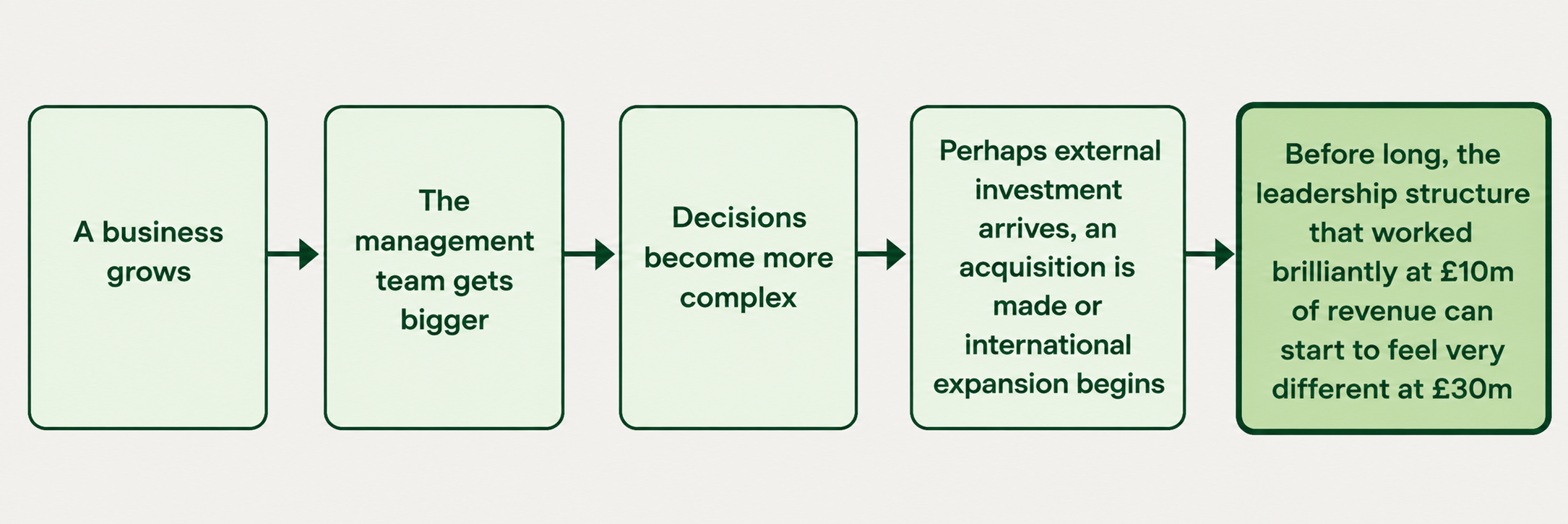
Perhaps the company is scaling rapidly. It might be expanding internationally, making acquisitions, moving into a new market, preparing for significant investment or simply becoming a much larger and more complex organisation.
The executives who created that success may still be absolutely the right people to take the business forward. But that doesn't mean they have encountered every challenge that comes with the next stage.
This is where a good NED can be enormously valuable. Someone who has already navigated a similar journey can bring pattern recognition into the boardroom: what tends to go wrong, what deserves attention early and which decisions are difficult to reverse later.
Importantly, that doesn't mean telling the executive team how to run the business.
The best NEDs combine experience with perspective. They have seen the movie before, but understand that this company will have its own version of the story.
This is probably one of the most interesting situations. A leadership team identifies a capability it needs.
Perhaps greater experience of M&A. International growth. Digital transformation. Manufacturing scale-up. Funding. Governance. Exit preparation. A particular sector.
The natural response is often to start designing an executive role.
Sometimes that is absolutely the right answer.
But before committing to another permanent senior hire, it is worth asking a different question:
Do we need somebody to execute this every day, or do we need somebody with the experience to help us make better decisions about it?
Those are very different requirements.
There are times when an adviser, consultant or fractional executive will be appropriate too. But there are also situations where a NED provides the best combination of continuity, independence and specialist experience.
Rather than adding another executive into the organisation, you strengthen the capability around the existing team.

Certain events naturally force businesses to think differently about their boards.
External investment is an obvious one.
Investors are not simply assessing the financial performance of a company. They are considering the leadership team, the quality of decision-making, the capability around the table and whether the organisation has the structure to deliver its next phase.
The same applies when preparing for an eventual exit, succession or another significant transaction.
A well-chosen NED can add experience well before the event itself.
They can help a leadership team ask the questions a future investor or acquirer is likely to ask. They can challenge assumptions, identify capability gaps and help the organisation prepare for the next stage rather than react to it.
One lesson from my time working alongside investment teams is that leadership quality and organisational structure matter enormously to the investment story.
A great business with an incomplete leadership structure can still create uncertainty.

Strong leadership teams are often close-knit.
That is usually a strength.
But the longer people work together, the easier it becomes to develop shared assumptions. Founders in particular can find themselves surrounded by people who understandably see the business through a similar lens.
At some point, independent challenge becomes valuable.
Not challenge for its own sake.
A strong NED should be supportive of the CEO and executive team while still being sufficiently independent to ask:
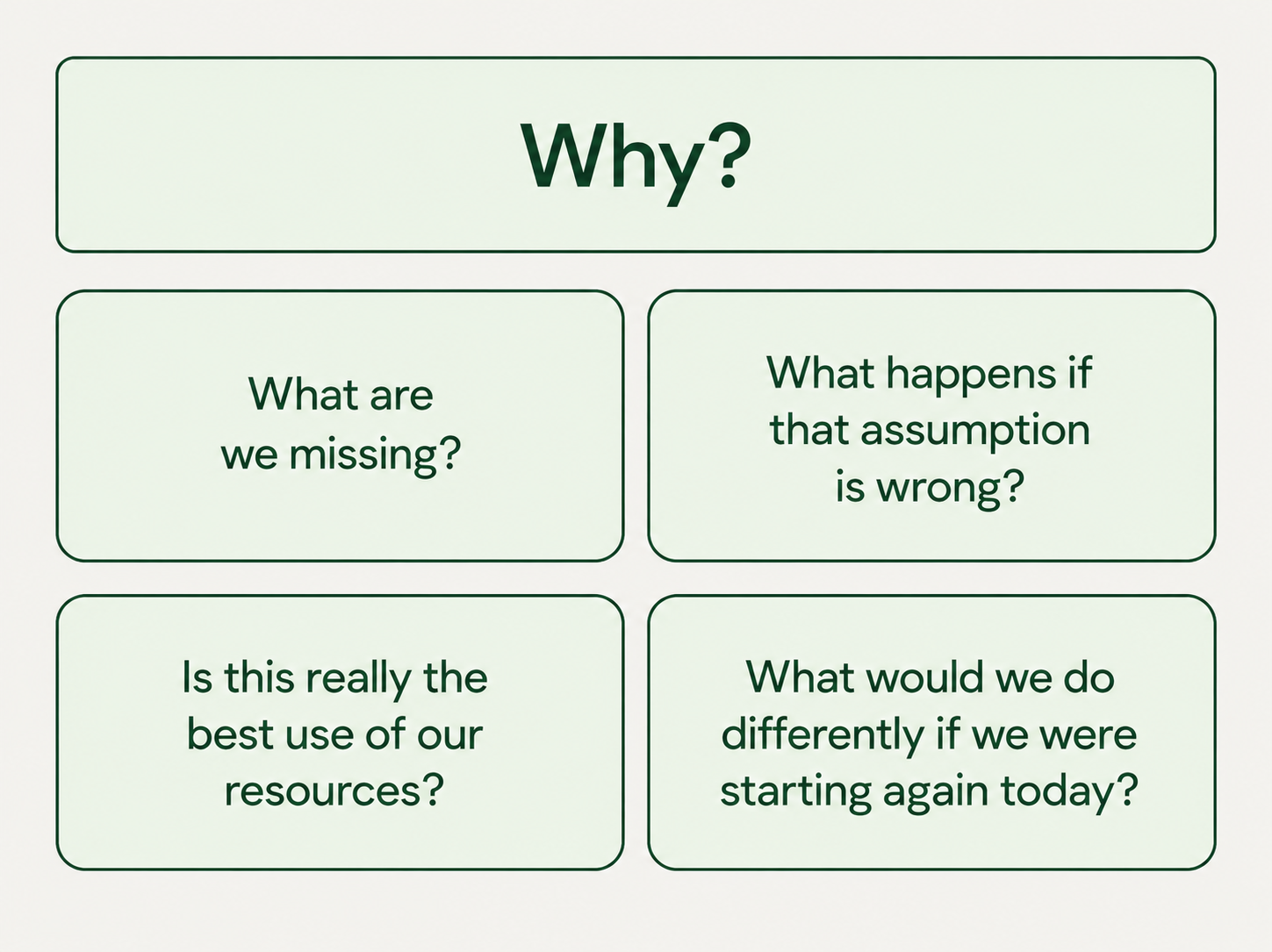
That ability to challenge constructively – while retaining the trust of the people running the business – is one of the most valuable qualities a NED can bring.
It is also one of the hardest to replicate through an informal adviser or occasional consultant.

There is another reason for appointing a NED that is less frequently discussed.
Leadership can be lonely.
The most difficult decisions often can't be delegated. And there are subjects that CEOs understandably cannot always discuss openly with their management team.
A good Chair or NED can provide a valuable additional relationship.
Someone sufficiently removed from the day-to-day operation to retain perspective, but sufficiently close to the business to understand the context.
That combination matters.
The NED isn't there to become another executive, and nor should they become an unquestioning supporter of the CEO. Their value comes from being able to support, challenge and advise in equal measure.
For the right founder or CEO, that relationship can become one of the most valuable around the board table.
Sometimes the answer is another permanent executive.
Sometimes it is a fractional leader, specialist adviser, consultant or an investment in developing somebody already within the organisation.
And sometimes the existing team simply needs time to execute.
But I do think NED appointments are too often considered only once a business reaches a certain size, receives external investment or feels that it has become sufficiently “corporate”.
I would encourage founders and CEOs to think about it differently.
Start with the challenge rather than the role.
What does the organisation need to achieve next?
What experience is missing around the table?
Is that capability required operationally every day, or would the business benefit more from somebody who brings experience, independence, challenge and perspective?
The answer to those questions should determine the solution.
And increasingly, I think the right NED deserves to be one of the options on the table.