Dan Wood on Hawsons, ICAEW Sheffield and What Comes Next
As Dan Wood prepares to take the Chair of the ICAEW Sheffield Network in its landmark 150th year, we speak to the Hawsons Partner about leadership, the strength of South Yorkshire’s business community, and the importance of relationships, trusted advice and developing the next generation of professionals.
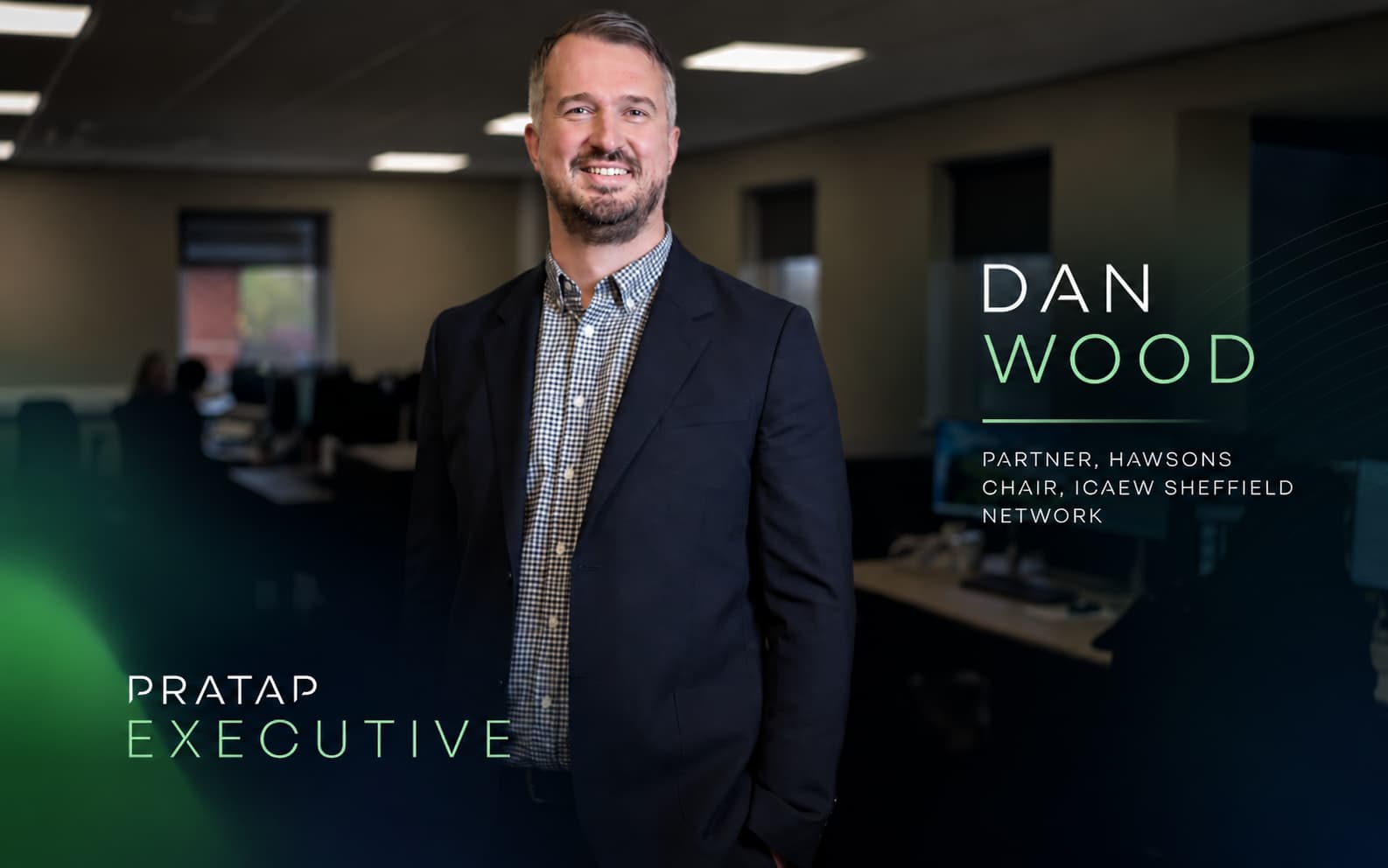
Dan Wood has been a close contact of our team for many years. We first got to know him through the Sheffield and District Chartered Accountants Student Society and have watched his progression with great interest ever since. Following seven years in the Doncaster office, he became a Partner at Hawsons in 2021 and is now one of the leading younger voices within the South Yorkshire professional community.
Deeply connected to both the region and the profession, Dan combines a modern, people-focused leadership style with a genuine appreciation for the long-term stewardship that sits at the heart of firms like Hawsons and organisations such as the ICAEW Sheffield Network. His perspective on trusted advice, sustainable growth and developing future generations of professionals comes through clearly across every part of the conversation.
Dan now takes on the prestigious role of Chair of the ICAEW Sheffield Network in July, with the added distinction of holding the position during its landmark 150th year. It is a fitting appointment for somebody who has built his career around long-term relationships, supporting businesses through change and helping shape the future of the profession across South Yorkshire.
You take over as Chair of the ICAEW Sheffield Network in its 150th year. How did the opportunity come about, and what does it mean to you personally and professionally?
I have been involved with the Sheffield Network for several years now, initially through the student and young professional side before stepping onto the senior committee around four or five years ago. Hawsons has always had a strong connection with the network and the wider profession, so there has always been a feeling within the firm that it is important to contribute and support the professional community locally.
The opportunity itself developed over time through conversations with Stratton Brock (Chair for the past two years) and others on the committee. One of the things they were keen to do was continue broadening the representation on the board and bring through younger members alongside the experience already there. Timing was important for me personally as well. I have a young family and when the conversations first started, we had our second child on the way, so there was a genuine discussion around when the right time would be to step into the role.
To then take on the Chair position in the 150th year of the Sheffield Network is a real privilege. I only realised the significance of the anniversary at the annual dinner itself, but it does feel special. Hawsons is now in its 171st year, so there is something quite fitting about representing a long-standing independent firm during such an important year for the network as well.
More than anything, there is a sense of pride in being part of that history and helping ensure the network continues to evolve and support future generations of professionals across the region.
As you step into the Chair role, what role do you think the ICAEW Sheffield Network can play in supporting and strengthening the business community across Sheffield and South Yorkshire?
South Yorkshire has a very strong business and professional community already. I have had the benefit of working across both Sheffield and Doncaster during my career, and while the two areas can feel slightly different at times, there is a huge amount of commonality as well.
One of the strengths of organisations like the ICAEW Sheffield Network is that they provide a constant within a changing market. Over recent years, we have seen significant change across the accountancy profession, the legal market and the banking landscape, so having networks that bring people together, encourage collaboration and support professional development becomes increasingly important.
I also think there is a real opportunity for the network to continue strengthening relationships with organisations such as the Chambers of Commerce, LEPs and the wider business community. Ultimately, the more connected those groups are, the more positive impact they can have across the region.
From my own perspective as an advisor, the role of accountants has evolved significantly as well. There was a LinkedIn post recently criticising how many accountants now describe themselves as “business advisors”, but I think for ICAEW members that advisory role is genuinely embedded within the qualification and the profession. We are not simply looking at debits and credits. We are helping businesses think about financial management, technology, strategy, succession and long-term planning.
That broader perspective is particularly valuable in uncertain markets. Quite often, the best thing clients can do is speak to their advisors early, before making significant decisions, rather than asking people to resolve issues afterwards. Strong relationships and early conversations make a huge difference.
You have spent your entire career at Hawsons. What is it about the firm, its culture, and its people that has enabled you to develop and build such a successful career there?
I joined Hawsons as a graduate in 2012, initially within the audit team in Sheffield working with larger corporate clients, before moving across to the Doncaster office as a manager and eventually becoming a Partner.
What has kept me here throughout that time is probably the variety. I have been fortunate to work across a broad range of clients, sectors and service lines, which has continually kept the role interesting and allowed me to develop in different directions.
At the same time, the firm itself has evolved considerably. During my early years, there was a new generation of younger Partners coming through and over time, we became more focused on clearly articulating the culture and identity of the business. We developed a clearer set of values, vision and purpose statements, not necessarily because those things did not already exist, but because putting them into words gives everyone a common direction and something to measure decisions against.
I think that has been really important. Those values are not simply words on a page. They are built into how we make decisions, how we assess people and how we think about the future of the firm.
The culture within the Doncaster office is something I am particularly proud of as well. We have good clients, good people and a genuinely supportive environment, which makes it an enjoyable place to work and develop a career.
I have also been fortunate to work alongside strong role models throughout my career. Chris Hill interviewed me as a graduate and later became the senior partner when I made Partner myself. He also encouraged me to get involved with the ICAEW network and has had a long involvement with the profession locally, so there is definitely a sense of baton passing there which has been nice personally.
You are closely associated with Doncaster, the surrounding region, and the agricultural sector. What are you seeing in that market at the moment, and why has it remained such an important focus for you?
I feel privileged to work in Doncaster because it is where I grew up. While I knew a lot of people personally in the area, one of the things that surprised me when I moved across to the office was that I did not initially know many people within the professional community. Building those relationships and networks over time has been really rewarding.
In terms of agriculture, I inherited responsibility for that specialism when Martin Wilmott retired in 2022, although I had worked alongside him for a number of years beforehand. Looking back, it was quite a significant time to step into the sector given the changes around inheritance tax, succession planning and wider economic pressures affecting farming businesses.
What I have learned very quickly is that agriculture is about much more than technical accountancy advice. Understanding the people, the family dynamics and the long-term implications of decisions is often just as important.
A lot of those conversations are not happening in boardrooms. They are happening around kitchen tables. These businesses are not simply commercial operations, they are livelihoods and often multi-generational family legacies, so trust and relationships become incredibly important.
Some of the most rewarding work we have done recently has involved helping farming businesses navigate succession challenges, mergers and restructures in a way that allows businesses and families to move forward positively.
Alongside the client work, I also sit on the technical committee for the Rural Accountancy Group and the ICAEW Farming and Rural Advisory Group. Those networks are valuable because they encourage collaboration and knowledge sharing across the profession rather than viewing everyone purely as competitors.
Ultimately, understanding clients and how to communicate advice effectively is often just as important as the technical advice itself.
The past six years have brought significant change to the accountancy profession. What have been the most important shifts in your view, and how has Hawsons responded to stay ahead?
One of the biggest changes, particularly within audit, has been the increased focus on quality and technical standards. That emphasis on quality is incredibly important and ties directly into one of the core values we have developed as a firm.
At Hawsons, we have invested heavily in strengthening that area of the business, including bringing in additional technical expertise to support our teams and ensure we continue delivering the highest standards of advice and service to clients.
At the same time, the wider expectations of employers and professional firms have changed significantly as well. COVID accelerated many of those shifts around flexible and agile working, and like many firms, we had to adapt quickly. What was important for us, though, was making sure the changes we introduced were thoughtful and sustainable rather than simply reacting in the moment.
Retention and progression remain hugely important for us. Without retention, you cannot create long-term progression opportunities for people, and one of the strengths of Hawsons has always been the continuity we can offer both clients and employees.
It is also important to recognise that younger generations entering the profession have had very different experiences from those before them. Some joined the profession having never sat formal exams due to Covid disruption, while others missed key parts of university life and early professional development. As employers, we have had to adapt our support structures accordingly and think differently about how we develop and retain talent.
At the same time, while we place a strong focus on developing people internally, bringing in external talent and fresh perspectives is equally valuable in helping the business continue evolving.
As you look forward, how do you see the next phase developing for Hawsons, and what are your own ambitions over the coming years?
It is a very exciting time for Hawsons. The firm has seen strong growth over recent years, and we are keen to continue building on that in a sustainable way while maintaining the quality of service and advice that clients expect from us.
The Doncaster office alone has grown significantly, with headcount increasing by around 50% over the past five years to around 26 people across all service lines. That growth brings challenges as well as opportunities, but it is a positive reflection of the direction the business is moving in.
One of the great advantages of being an independent firm is that we remain masters of our own destiny. We have the opportunity to shape the future of the business ourselves and continue pursuing the opportunities that genuinely fit the culture and ambitions of the firm.
Personally, I still feel I have a long career ahead of me at Hawsons and being able to help shape the future of such a long-standing and respected business is something I take a great deal of pride in.
I have always had the ambition to become a Partner within one firm and grow alongside the business over the long term. I still remember Chris Hill asking me during my graduate interview where I saw myself in twenty years and my answer at the time was “doing your job”. He reminded me of that when I became Partner, which was a nice moment looking back.
For younger professionals entering the industry today, there are many different career paths available, but for me the opportunity to grow within one organisation, take on increasing responsibility and genuinely influence the direction of the business has been incredibly rewarding.