Leading Through Growth: Carol Smith’s Journey from Recruiter to Group Head of HR
As Group Head of HR at Superior Wellness, Carol Smith leads the people strategy behind a rapidly growing international business. In this interview, she reflects on her journey from recruitment into senior HR leadership and shares her perspective on culture, growth and strategic people leadership.
Leading Through Growth: Carol Smith’s Journey from Recruiter to Group Head of HR
As Group Head of HR at Superior Wellness, Carol Smith leads the people strategy behind a rapidly growing international business. In this interview, she reflects on her journey from recruitment into senior HR leadership and shares her perspective on culture, growth and strategic people leadership.
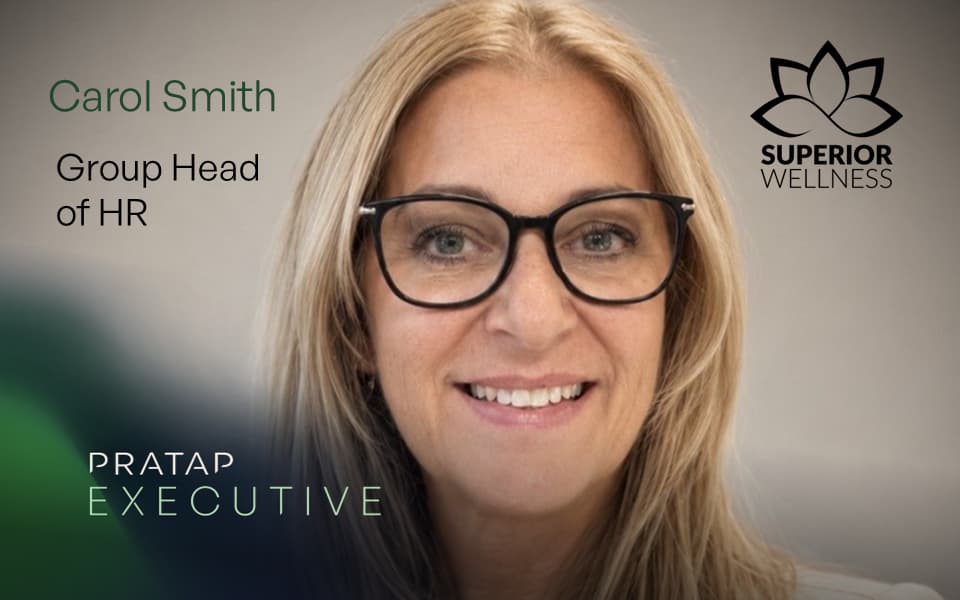
People leadership rarely follows a straight line. Many of the most effective HR leaders arrive there having experienced business from different perspectives first.
Carol Smith is a great example of that journey. Beginning her career in recruitment before moving into senior HR leadership roles. She is currently the Group Head of HR at Superior Wellness in Chesterfield – an entrepreneurial SME that is scaling globally from their base in Chesterfield. We have recently had the pleasure of working with Carol on an executive search assignment within the business and have thoroughly enjoyed getting to know her. As you might expect from a client with a recruitment background, the process ran like clockwork.
At Superior Wellness, Carol leads the global people agenda across teams in the UK, Portugal, the US, Canada and Europe, helping shape the culture and people strategy during a period of significant international growth.
In this interview, Carol reflects on her journey from recruitment into HR leadership, what she has learned working alongside entrepreneurial leaders, and the role people leaders play in helping organisations scale successfully.
Tell us about your role at Superior Wellness
As Group Head of HR at Superior Wellness, I lead the global people strategy across our operations in the UK, Portugal, the United States, Canada and Europe. My role is focused on ensuring we have the right people, culture, leadership capability and organisational structure in place to support the business as it continues to grow internationally.
As part of the Executive Leadership Team, I work closely with the Board and senior leaders on a wide range of strategic people initiatives, including workforce planning, talent acquisition, succession planning, organisational development, employee engagement, reward and benefits, and organisational change.
One of the things I enjoy most about the role is the variety. No two days are the same. Whether I am supporting leadership development, helping to integrate new teams, navigating employment legislation across different countries, or driving cultural initiatives, my focus is always on creating an environment where both the business and its people can thrive.
The journey from recruiter to HRD
You began your career in recruitment before moving into senior HR leadership roles. How did that journey unfold, and how has your experience in the talent market shaped the way you approach people leadership today?
My career began in recruitment, where I had the opportunity to work closely with both candidates and employers across a wide range of industries. It gave me a strong commercial understanding of businesses, talent markets and what attracts people to an organisation. More importantly, it gave me a unique insight into workplace culture from both perspectives.
I regularly met candidates who spoke passionately about organisations where they felt valued, recognised and inspired to perform, but I also met many who described cultures where they felt unsupported, disengaged or simply like a number. Those conversations made me realise that leadership and culture have a profound impact on both individual wellbeing and organisational success.
As I built trusted relationships with clients, I found myself doing far more than recruiting. I was sharing feedback from candidates and employees, challenging leaders to think differently about engagement, reward and recognition, and helping them understand that creating a positive workplace culture was not simply an HR initiative but a commercial advantage. Seeing businesses embrace those ideas and witnessing the positive impact they had on retention, performance and employee satisfaction was incredibly rewarding.
Over time, I realised I no longer wanted to influence organisations from the outside looking in. Whilst I had developed the ability to identify exceptional talent and match individuals to organisations where they would thrive, I wanted to play a bigger role in shaping those organisations themselves. I wanted to create workplaces where people felt safe, valued, listened to and able to achieve their full potential.
That ambition led me into my HR career, where I could influence the entire employee experience, from attracting and developing talent through to leadership, organisational development and cultural transformation. My recruitment background remains one of my greatest strengths. It gave me a commercial mindset, sharpened my ability to identify potential, strengthened my influencing skills and reinforced the importance of aligning people strategy with business strategy.
Today, I still approach every people decision through that lens. Successful organisations don't simply recruit great people; they create environments where those people choose to stay, grow and perform. I believe HR has a unique opportunity to build those environments by putting people at the heart of business whilst delivering measurable commercial value.
People leadership with entrepreneurs
Much of your career has involved working alongside entrepreneurial leaders and founder-led businesses. What makes people leadership in those environments distinctive, and what have you learned about supporting founders and leadership teams as businesses evolve?
Working alongside entrepreneurial leaders has been one of the most rewarding aspects of my career. Founders often have an incredible vision, passion and drive. They are typically decisive, resilient and prepared to take calculated risks, creating fast-paced environments where innovation and opportunity thrive.
As organisations grow, however, the leadership challenges inevitably change. The informal ways of working and instinctive decision-making that are highly effective in the early stages of a business do not always scale alongside international growth, larger workforces and increasing organisational complexity. At that point, people leadership becomes just as important as commercial leadership.
One of the biggest lessons I have learned is that HR should never seek to change the entrepreneurial spirit that made the business successful. Instead, our role is to protect it whilst introducing the right level of structure, governance and leadership capability to support sustainable growth. It is about creating clarity without creating unnecessary bureaucracy.
Supporting founders through that evolution means building trusted relationships where you can both support and challenge. There are times when HR's role is to provide reassurance, and there are times when it is to offer an alternative perspective based on people insight, organisational risk or long-term business sustainability. Those conversations require credibility, commercial acumen, emotional intelligence and the confidence to constructively challenge when necessary. The most effective HR leaders don't simply support business decisions; they help shape them.
Ultimately, I have learned that the most successful founder-led businesses are those where people strategy evolves alongside business strategy. When founders recognise HR as a strategic partner rather than a support function, it enables stronger leadership, better decision-making and an organisational culture that continues to grow without losing the values and entrepreneurial energy that made the business successful in the first place.
People leadership while scaling rapidly
You have worked with organisations going through periods of rapid growth. From a people perspective, what are the key challenges businesses face as they scale, and what role should HR leaders play in helping organisations grow while maintaining culture and performance?
Rapid growth is an exciting phase for any business, but it also places significant pressure on its people, leaders and culture. Whilst recruitment is often the immediate priority, scaling successfully is about far more than increasing headcount. It requires organisations to develop leadership capability, establish clear structures, strengthen communication and ensure their culture evolves alongside the business rather than being left behind.
In my experience, one of the greatest risks during periods of rapid growth is assuming that the culture will simply look after itself. The behaviours, relationships and ways of working that naturally exist within a smaller business become much harder to maintain as teams expand, new markets are entered and operations become increasingly complex. Without a clear people strategy, organisations can quickly experience inconsistent leadership, reduced engagement and a disconnect between business values and everyday behaviours.
This is where HR has a critical role to play. We should not simply respond to growth; we should help shape it. That means working alongside leadership teams to build organisational capability, develop future leaders, create robust succession plans, strengthen employee engagement and ensure the right structures, processes and governance are introduced at the right time. The challenge is doing this without losing the agility and entrepreneurial mindset that often drives a company's success.
For me, HR's role is to act as a strategic business partner, ensuring that people strategy is fully aligned with commercial objectives. When HR has a seat at the leadership table, we can anticipate future workforce needs rather than react to them, helping businesses scale sustainably whilst protecting the culture that differentiates them.
Ultimately, successful growth is not measured by the number of people an organisation employs, but by its ability to develop high-performing teams, retain great talent and create an environment where people and the business continue to thrive together. Culture should never be viewed as something that exists alongside growth, it should be the foundation that enables it. That is where HR creates lasting value.

Managing Partner