Scaling SaaS Success: The CFO Insights of Tom Webb
Tom Webb, a leading SaaS CFO in Yorkshire, shares insights on driving growth, balancing profitability, and evolving as a modern finance leader, with a glimpse into how his personal pursuits shape his approach.
Scaling SaaS Success: The CFO Insights of Tom Webb
Tom Webb, a leading SaaS CFO in Yorkshire, shares insights on driving growth, balancing profitability, and evolving as a modern finance leader, with a glimpse into how his personal pursuits shape his approach.
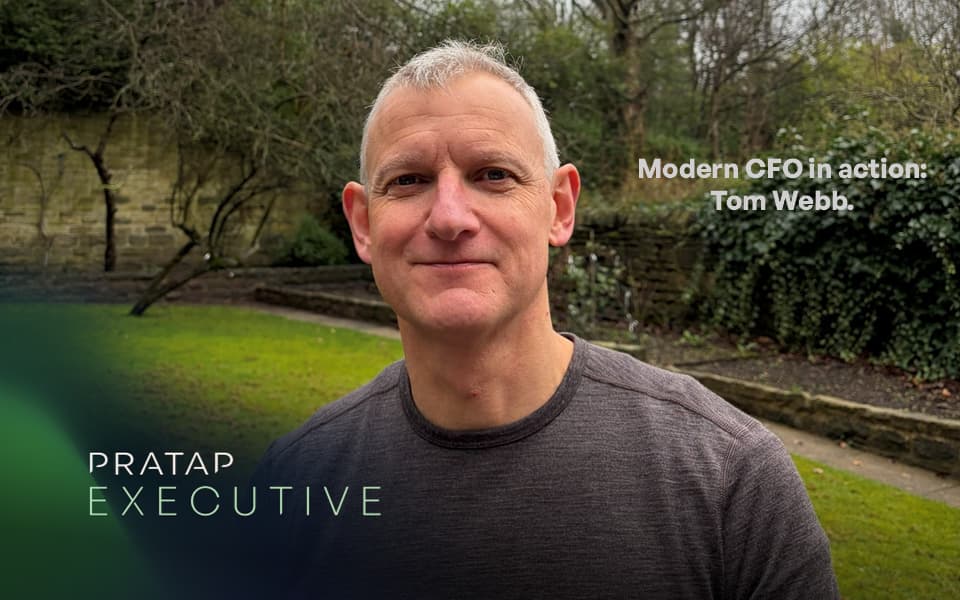
Tom Webb is one of the region’s most experienced and respected SaaS finance leaders. An ACA-qualified CFO who began his career at KPMG in Leeds in 1994, Tom has gone on to build a 20+ year career scaling high-growth technology and PE-backed businesses.
His impressive journey has included senior leadership roles at KCOM, Asda, Communisis, and, most recently, Tribepad - the BGF-backed recruitment software business headquartered in Sheffield. During his time there, the business has grown and the company achieved a series of major certifications and awards for product excellence, sustainability and business performance.
As the SaaS sector continues to boom across Yorkshire and the North, we caught up with Tom to explore what makes the CFO role in this sector uniquely challenging -and uniquely rewarding. As I spoke to him, he had just stepped up his ultra-marathon training – A man of many, talents!
SaaS CFO market dynamics
You have become one of the go-to finance leaders for SaaS businesses in our region. The number of CFO appointments in the sector has risen year on year — reflecting investment, market growth and the need for specialist skills.
What makes the SaaS world different for CFOs, and what are the rewards of leading in this space?
SaaS has a set of expectations attached to it that are very different from the traditional businesses I grew up with and that once dominated the UK. There is an assumption of hyper growth, the ability to land and expand into new markets, and to move internationally at relatively low cost, with scalability seemingly handled by third parties in data centres somewhere in the world.
Somewhere within that sits the truth, and understanding the myth versus the reality is critical. Getting that right is what allows CFOs to align the ambitions of investors and stakeholders with the real objectives and capabilities of the business.
There is also a much sharper focus on risk. Understanding how risk impacts the business commercially, particularly around cloud infrastructure, FINOPs and the allocation of technology costs to the services being delivered, creates real data and decision making challenges. For CFOs who enjoy that complexity, it is also one of the most rewarding aspects of the role.
What matters most in the sector?
Whatever you do, consistency is critical, and CFOs need to measure the business in a way that mirrors how an investor will assess it. The starting point for many is the Rule of 40, with the Rule of 50 increasingly part of the conversation. Ultimately, it is the balance between growth and profitability that earns you the right to have a serious discussion.
That said, it is vital to be clear about where you are in your operating cycle and what the right mix needs to be between ARR growth and EBITDA at that point in time. How you achieve those outcomes matters just as much as the headline numbers, as does what they mean to a future owner and the underlying quality of both revenue and EBITDA.
One of the most common mistakes I still see is a lack of clarity and alignment around what good actually looks like. Teams can become overly focused on the trajectory towards the next deal without being clear about where value is truly being created. In SaaS, that often comes down to understanding whether you are operating a transactional platform or an outcome based model, and being honest about where you sit on that spectrum. If the model is largely transactional, the question then becomes whether that is sustainable over the long term, particularly in a world where AI is rapidly changing customer expectations and economics.
The traditional → modern CFO journey
Your background is the classic route: Big 4 training, senior roles in large corporate and PE-backed organisations, then into C-Suite leadership in fast-growing SMEs. How has that blend of experience shaped your approach and style as a CFO?
I have been fortunate that my career has given me exposure to different industries, organisations of very different sizes, and some exceptional leaders and cultures. Early on, I was very numbers focused, and I still remember a business partner saying to me that finance people often think the hard work is done once the budget has been signed off.
There have been plenty of moments where I learnt key lessons the hard way, and getting things wrong once certainly helps you learn quickly. Over time, I evolved from being a purely numbers driven finance leader into someone far more people centric, moving away from the idea that everything needs to be written down and run like a perfectly organised diary. Along that journey, I also learnt how different leaders create impact in different situations, and just as importantly, how and when to communicate different messages.
I do not believe one leadership style fits every situation. For me, it starts with being true to myself and anchoring everything around a small set of core behaviours: putting the team first, acting with integrity by owning mistakes and moving on, bringing positivity as an energy giver rather than a taker, showing kindness by supporting others, and being relentless in seeing things through to the end.
Beyond that, it is about listening to people, teams and the wider organisation, and consciously leaving your ego at the door. Understanding how to make the right impact at the right time really matters, as does recognising the consequences of getting it wrong. I have seen new board members rush to make the big decision and enjoy the plaudits, only to realise 12 months later that the decision was ego driven and has ultimately damaged the organisation.
CFO evolution
How are the challenges facing CFOs today different from those you saw 10–15 years ago?
The biggest change is the expectation placed on senior finance professionals. Today, CFOs are expected to add value well beyond the numbers, with a clear voice both strategically and operationally. We have seen that very clearly in areas such as ESG, where many CFOs have become central to reporting and leadership.
There is also an expectation to be genuinely customer centric, to be part of commercial discussions, to lead key relationships and to operate effectively within a matrix commercial team. For many roles, that has become a prerequisite rather than a differentiator.
Hand in hand with this is the progression of many CFOs into broader leadership roles, including leading entire businesses. Without a deep understanding of how a business runs day to day, week to week and month to month, the value a CFO can add will be limited. That requires knowing the detail, being more curious and asking more operational questions.
Finally, the nature of risk has changed significantly. Globalisation, cloud computing, GDPR and now AI all introduce new risks that need to be managed both internally and across customer and supplier relationships. CFOs are often best placed to step back, assess those risks with a more neutral lens than commercial or operational teams, and make clear, balanced recommendations on how the organisation should proceed.
And looking ahead — what do you expect will define the CFO role in 2035?
Looking ahead, I expect to see more CFOs adopting broader roles as they are increasingly expected to add value across the whole business. Those who do that well will naturally be given greater responsibility over time.
The real opportunity to enhance value, however, sits in data. CFOs are, by nature, analytical and comfortable working with complex information. With the continued advancement of AI, the expectation will be that finance leaders not only interpret new insights, but also create and leverage the structures, systems and tools needed to turn data into genuine strategic advantage.
What is the next chapter for you?
Making a meaningful difference is what excites me most, whether that is for the people I work with, colleagues or customers. I do not have a fixed view of exactly what the next chapter looks like, but I believe in moving forward and seeking out challenges that continue to make me a better leader.
My expectation is that SaaS and technology more broadly will remain an exciting and dynamic space for a number of years to come, and that is where I see the greatest opportunity to continue learning, contributing and creating impact.
A moment away from the numbers…
You are a qualified hockey coach and passionate runner — are you the same person on the hockey pitch, the running track and the boardroom?
I would say yes, and all three share the same opportunity for me to challenge myself by doing something new and uncomfortable. I never played hockey, so the learning curve has been steep. In some areas I have had to accept my limitations, but that has also allowed me to lean into my strengths around analytics, team dynamics and one to one development with players.
I really enjoy the player development aspect of coaching and how that connects with the strategic side of the sport. I am also very competitive, and in sport you get very direct feedback on how you are doing, often on a weekly basis, which makes managing emotions an interesting challenge in its own right.
Running gives me a different kind of challenge. It brings both mental and physical adversity, whether that is choosing to run in poor weather or returning from injury. Over time, I have developed a mindset that focuses on simply getting out and doing it. I remember reading a phrase that really stuck with me: “I am a runner, therefore I run.” When I start to debate the weather instead of my fitness, that is all the motivation I need.

Nik Pratap - Managing Partner
Click here to access our 2025/26 CFO Network Annual Report