Quarterly Job Market Overview - February 2026
This quarter’s review combines national labour market data with our regional insight to give a clear, practical view of current hiring conditions and what they mean for workforce strategy.
Quarterly Job Market Overview - February 2026
This quarter’s review combines national labour market data with our regional insight to give a clear, practical view of current hiring conditions and what they mean for workforce strategy.

People Pulse - Regional Insight
Our objective is to give our network the most relevant data and practical insight on the people metrics that matter most to workforce and talent strategy. Each quarter, we bring together national labour market indicators with regional and functional insight, helping CPOs and HRDs separate noise from what genuinely requires attention.
Our analysis draws on a combination of our own market data, live candidate and employer insight, and trusted external sources. These include official labour market statistics from the Office for National Statistics, employer confidence and hiring sentiment from the Recruitment and Employment Confederation and their quarterly Jobs Report, alongside KPMG, and broader economic and wage commentary from the Bank of England. We also reference research from the Chartered Institute of Personnel and Development and sector-specific insight from professional bodies and market reports across finance, HR, commercial and operations roles.
By combining national data with regional and functional perspective, we aim to provide a balanced, evidence-led view of current conditions, alongside our own interpretation of what these trends mean in practice for employers across the regions.
People Pulse dashboard

Regional Variances
- The decline in the job market and growth of unemployment are consistent across all areas of the UK – with the exception of the Midlands. The job market improved slightly within this region. Although this growth was only marginal, it represents a sharp change from the steep from in London and the North.
Sectors under the spotlight
Looking at the permanent job market across the UK, the most significant drops in demand were in:
- Clerical (being the steepest drop)
- IT & Computing
The reliability of national data on these domain specialisms is a little more questionable. We analyse the job boards such as Indeed, Total and LinkedIn to form a view of the specialism that are most in demand:
- Finance
- Commercial
- Digital
Our Data and analysis
Our analysis of leadership moves in Yorkshire and East Midlands over 2025 gives a good indication of where the demand for staff lies
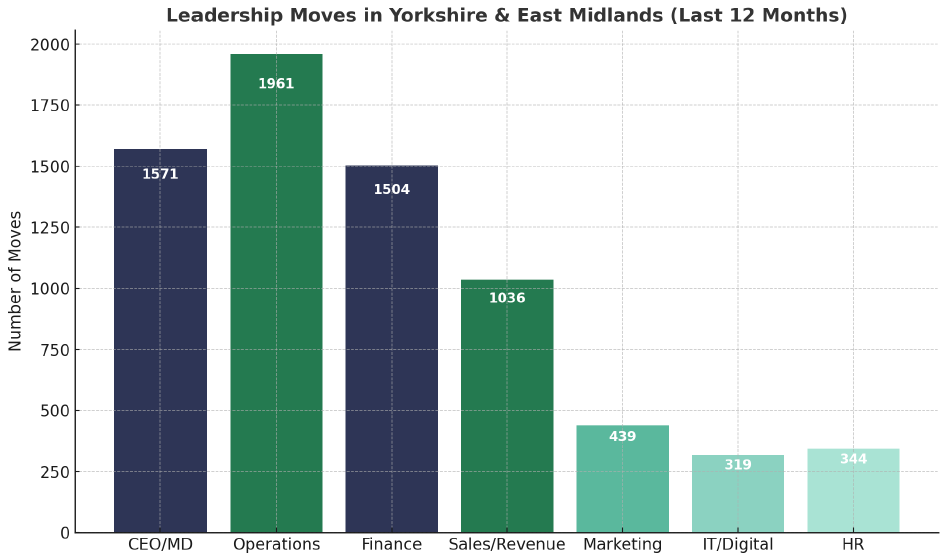
From our analysis, operational roles continue to account for the highest volume of recruitment activity across core domains. This is driven less by growth hiring and more by the need to sustain day-to-day delivery in an environment of ongoing cost pressure, process change and workforce churn. Operations functions are typically closest to customers, production, and service delivery, making gaps harder to absorb for long periods. As organisations focus on productivity, efficiency and resilience rather than expansion, maintaining operational capability becomes a priority, leading to continued replacement hiring even as overall vacancy levels soften.
Our View
From our perspective, the market remains cautious but far from inactive. We have seen a number of high-profile business failures and restructurings hit the headlines in recent months, including National Timber Group, Leedale, CF Booth, Warwick Ward and the Original Factory Shop, which has understandably reinforced a more guarded sentiment among boards and executive teams. Alongside this, redundancy activity has been more visible, particularly in businesses exposed to prolonged cost pressure, weaker consumer demand, or delayed investment decisions.
However, this is only part of the picture. In our day-to-day work with employers across the regions, we continue to see sustained demand for roles that protect delivery, productivity and resilience. Organisations may be pausing discretionary hiring, but they are not standing still. Operational capability, senior leadership and roles closely tied to transformation, efficiency and value creation remain active areas of focus. This is reflected in our own data, where the number of new roles worked on across our business is 5% up year on year, with growth of 12% within our executive search activity.
What this points to is a more selective and disciplined hiring environment rather than a widespread retreat. Employers are being clearer about where talent genuinely moves the dial, prioritising critical roles while keeping overall headcount growth under tight control. For people leaders, the challenge is less about whether hiring is happening and more about ensuring investment is directed at the roles that will matter most over the next 12 to 24 months.