Quarterly Job Market Overview - May 2026
This quarter’s review combines national labour market data with our regional insight to give a clear, practical view of current hiring conditions and what they mean for workforce strategy.
Quarterly Job Market Overview - May 2026
This quarter’s review combines national labour market data with our regional insight to give a clear, practical view of current hiring conditions and what they mean for workforce strategy.

People Pulse - Regional Insight
The labour market continues to present a mixed and evolving picture for employers across the regions. While headline vacancy levels remain below recent highs and business confidence continues to fluctuate, demand for critical leadership, operational capability and transformation-focused roles remains resilient in many parts of the market.
At the same time, several high-profile restructurings and administrations across Yorkshire, the Midlands and the wider UK have reinforced a more cautious backdrop for hiring. Employers are increasingly focused on productivity, efficiency and targeted investment, leading to a more selective recruitment environment rather than a widespread slowdown in activity.

This quarterly overview brings together the latest labour market indicators, hiring sentiment and regional insight to help CPOs, HRDs and leadership teams understand the trends shaping workforce and people strategy. Our analysis combines data from the Office for National Statistics, the Recruitment and Employment Confederation, the Chartered Institute of Personnel and Development, and the REC/KPMG Report on Jobs, alongside our own regional search activity and market observations from across the North, Midlands and North West.
While national data points to a softer overall hiring market, our experience continues to show that organisations are still prepared to invest decisively where leadership quality, operational performance and long-term capability are viewed as business-critical.
People Pulse dashboard

Regional Variances
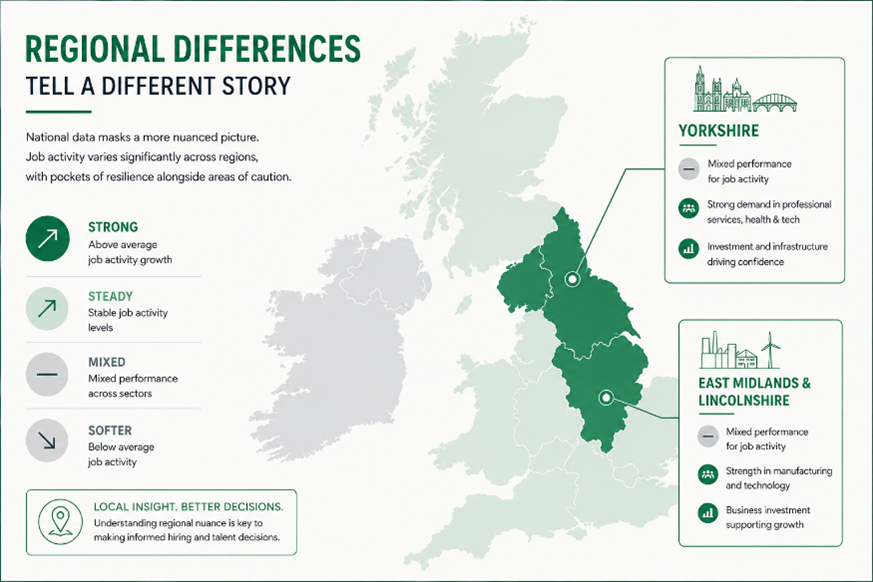
One of the most important observations from the current market is that regional economies are not moving uniformly. Labour market conditions across Yorkshire, the Midlands and the North West continue to be shaped by differing sector strengths, ownership profiles and levels of business confidence.
For employers, this creates a more nuanced environment for workforce planning. While some sectors remain cautious following cost pressures and economic uncertainty, others continue to face skills shortages and leadership gaps in operationally-critical areas. The result is a hiring market increasingly driven by priority and business impact rather than broad expansion.
Sectors under the spotlight
Activity levels continue to vary significantly by sector, with hiring decisions increasingly linked to productivity, operational resilience and long-term strategic priorities rather than broad expansion plans.
Manufacturing and engineering businesses across Yorkshire and the Midlands continue to show relatively strong levels of recruitment activity, particularly within operational leadership, supply chain, finance and transformation-focused roles. Many employers remain under pressure to improve efficiency and delivery capability, leading to continued investment in individuals who can strengthen operational performance and support change.
Private equity-backed and investor-led businesses also remain comparatively active. While investment timelines may have lengthened in some areas, leadership hiring continues where organisations are preparing for growth, integration, succession or future transaction activity.
In contrast, more discretionary hiring across support functions has softened, particularly within sectors more exposed to consumer demand and cost pressure. Recruitment activity in some commercial and head office functions has become more selective, with organisations placing greater emphasis on productivity, adaptability and broad capability rather than pure headcount growth.
From a functional perspective, operational roles continue to account for the highest volume of recruitment activity within our own data. These positions remain critical to day-to-day delivery and are often hardest for organisations to absorb when vacancies arise, particularly in businesses focused on operational performance, customer delivery and transformation.
What we are directly seeing
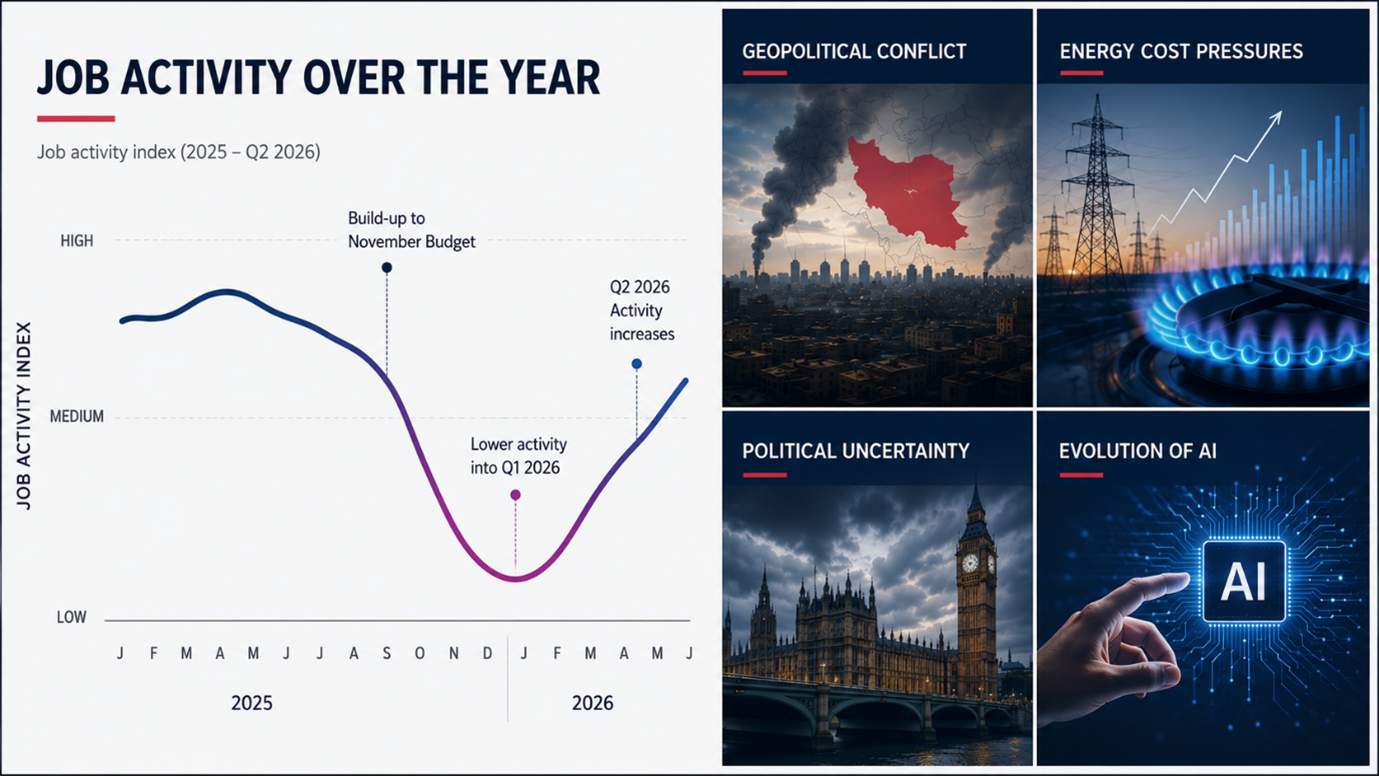
Interpreting labour market data has become increasingly challenging (but that will not stop us trying!), with employer confidence, political developments, inflation and global events all influencing hiring activity at pace. Trends are shifting quickly and headline data does not always reflect what employers are experiencing in real time.
There was a clear slowdown in recruitment activity in the build-up to the November Budget, with uncertainty impacting hiring volumes into Q1 2026 as many organisations paused decision-making and investment plans.
However, despite continued political uncertainty in the UK and the disruption caused by the US-Iran conflict, activity levels have strengthened during Q2. While the market remains selective, our own data points towards improving confidence in leadership, operational and other business-critical hiring.
The result is a labour market that remains difficult to generalise. National trends continue to matter, but the reality underneath is increasingly varied across sectors, regions and role types.
Our View
The market is not operating with the confidence or momentum seen during the post-pandemic recovery, but nor is it standing still. Hiring activity is becoming more selective and disciplined, with organisations continuing to invest where leadership, operational capability and long-term performance are viewed as critical to future success.